Most study schedules fail before midterms.
Not because students are lazy. Because they're built wrong — starting with a blank template, blocking out "study time" without knowing what's actually due, and optimizing for how a schedule looks rather than what it needs to accomplish. By week three, real life doesn't fit the template anymore, and the whole thing gets abandoned.
A study schedule that works isn't a color-coded calendar. It's a system built around your actual deadlines, your actual grade weights, and your actual life. This guide walks you through exactly how to build one.
Quick answer: To make a study schedule that sticks in college, start by pulling every deadline from every syllabus into one place, then rank assignments by grade weight (not due date), block fixed commitments first, assign study blocks by priority, build in 20% buffer time, and do a 10-minute reset every Sunday. PassAI automates the first step — it reads your syllabus and extracts every deadline and grade weight automatically — and sends a daily study plan email so you don't have to rebuild the schedule from scratch each week.
Why Most Study Schedules Fall Apart in Week Two
Open any "study schedule template" and you'll find the same thing: a blank weekly grid with time slots. Monday 9–10am: Study. Monday 10–11am: Study. It looks organized. It accomplishes almost nothing.
The problem is that these templates have no relationship to your actual semester. They don't know that your Organic Chemistry lab report is worth 25% of your grade and due the same week as your Statistics midterm. They don't know that you have Tuesdays and Thursdays completely blocked with back-to-back classes. They definitely don't know that the professor for your History course grades on participation points that accumulate weekly.
Three things that cause most study schedules to collapse:
1. No connection to real deadlines. If you build your schedule before looking at what's actually due, you're planning in a vacuum. The schedule feels complete, but it's not tied to reality. The first time a big deadline appears that you hadn't accounted for, the whole structure breaks.
2. No grade weights. Not all assignments are equal. Treating a 5% homework set with the same urgency as a 30% midterm is a time allocation mistake — and it's one of the most common ones. A good schedule weights your effort based on impact, not just due date proximity.
3. No built-in flexibility. Schedules that try to account for every hour fail fast. Life doesn't conform to blocks. One bad week — you get sick, a project runs long, family stuff comes up — and the rigid schedule becomes useless. If there's no slack, there's no recovery.
The fix isn't a better template. It's a different starting point.
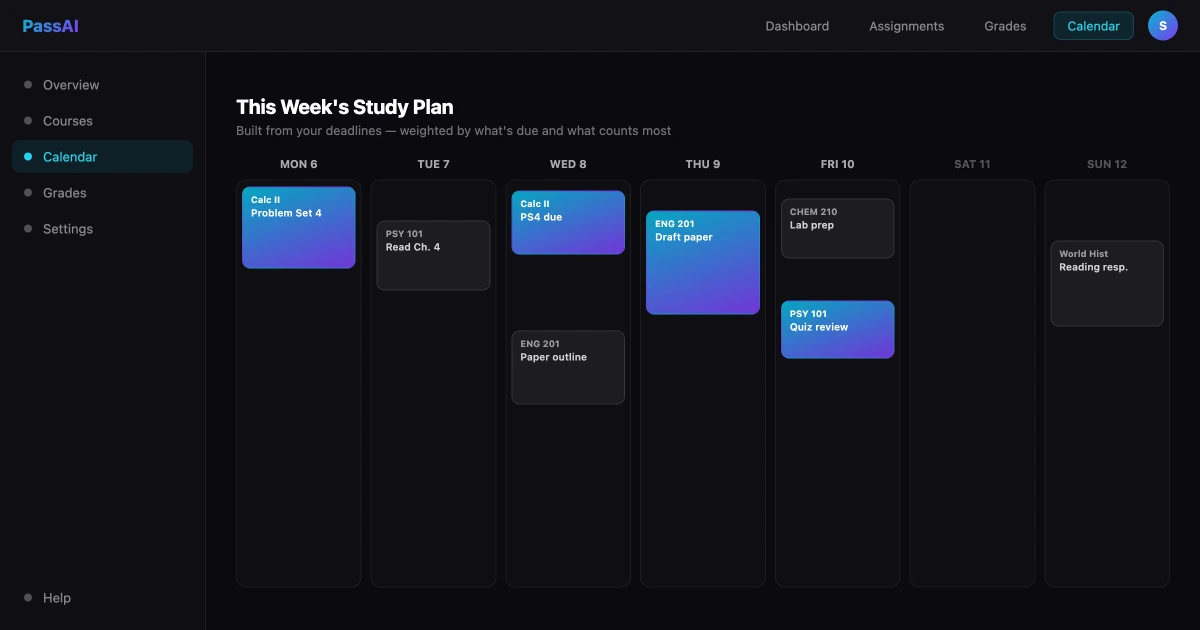
The 6-Step Study Schedule That Actually Sticks
Step 1: Pull every deadline before you touch a calendar
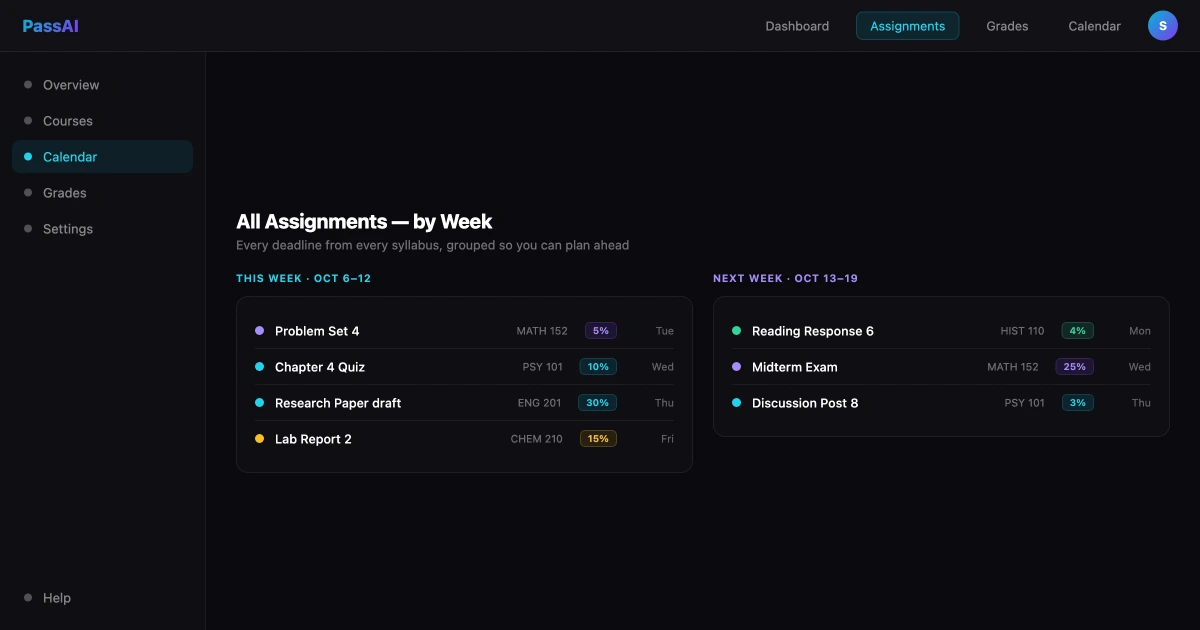
This is the step most students skip. Before you open any scheduling tool, you need a complete list of every graded item in every course — name, due date, and grade weight.
For a typical 15-credit semester, that's 5 syllabi, each with 15–30 graded items. Reading them all and extracting the relevant data takes 2–3 hours if you do it manually. That's why most students either skip it or do it halfway — and then wonder why they get blindsided by deadlines they didn't see coming.
The faster path: upload your syllabus to an AI tool. PassAI reads the PDF and extracts every assignment, exam, quiz, and grade weight automatically — usually in under 60 seconds per syllabus. The resulting dashboard gives you a complete map of your semester before you've scheduled a single study block.
Whether you do it manually or with AI, the principle is the same: never build a study schedule without first building a complete deadline inventory. Everything else depends on it.
What to capture for each item
Assignment name · Due date · Type (exam, paper, lab, quiz, homework) · Grade weight as % of final grade · Estimated time to complete
Step 2: Identify your high-stakes weeks
With your full deadline list in hand, look for weeks where multiple high-weight items collide. A week with a midterm worth 25% and a paper worth 15% due in the same 72-hour window is a different kind of week than one with a quiz worth 3%. You need to know these weeks exist in advance — not discover them the day before.
Mark these as "heavy weeks" in your calendar. They change how you plan the three weeks before them. A paper due Thursday of week eight means your serious writing work happens in weeks six and seven, not week eight.
This is also where grade weights change your priorities. If you're choosing between reviewing for a quiz worth 4% and starting a research paper worth 20%, the math tells you what to do — even if the quiz feels more urgent because it's tomorrow.
Step 3: Block your fixed commitments first
Before any study time goes on the calendar, block everything that can't move: class times, labs, work shifts, commute, sleep, recurring obligations. These are non-negotiable.
What's left after you block fixed commitments is your actual available study time — which is almost always less than students assume. Most college students have 20–30 hours of flexible time per week after fixed commitments. That sounds like a lot until you account for meals, exercise, downtime, and the fact that not all of that time is high-quality focus time.
Be honest here. If you try to schedule 8-hour study days on weekdays, you'll fail and blame yourself instead of the plan. Block what you actually have.
Step 4: Assign study blocks by priority — not alphabetically
Now assign your remaining time to subjects. The mistake is treating all courses equally. Instead, prioritize based on two factors: which classes have the most coming up (near deadlines) and which items carry the most grade weight.
A practical rule: courses with high-stakes deliverables in the next two weeks get 60–70% of your study time that week. The rest is distributed to maintenance — staying current on readings, reviewing recent material, preparing questions for class.
Rotate subjects across the week rather than batching them. Studying Chemistry on Monday, Wednesday, and Friday in 90-minute blocks produces better retention than a single 4-hour Chemistry marathon on Saturday. This is the spacing effect in practice — decades of cognitive science research confirm that multiple spaced exposures beat a single long session for long-term retention.
Step 5: Build in 20% buffer — the rule that saves the schedule
Most schedules fail because they're full. There's no room for anything to go wrong, and something always goes wrong.
The fix: plan for 80% of your available time. If you have 30 free hours in a week, schedule 24. Leave six unscheduled. Those six hours aren't wasted — they're absorbed by the assignments that took longer than expected, the study session that needed to go deeper, the emergency that came up Thursday afternoon. Without buffer, one disruption breaks everything. With buffer, disruptions are just absorbed.
This feels counterintuitive when you're staring at a heavy week and feel like you need every hour accounted for. But over-scheduled students consistently underperform over-buffered ones. A schedule you can actually execute beats an ambitious schedule you abandon by Wednesday.
Step 6: Do a 10-minute Sunday reset every week
A study schedule isn't a one-time setup. It's a weekly recalibration.
Every Sunday, spend 10 minutes on three things: look at what's coming in the next two weeks, check your grades to see where you stand in each class, and adjust your blocks for the week ahead. Move things if they've shifted. Add time to a class that needs it. Pull back from a class where you're comfortable.
This 10-minute habit is what separates the students who stick with their schedule from the ones who abandon it. The schedule you set in week one won't be the right schedule for week eight. The Sunday reset keeps it accurate.
How AI Makes This Faster — and More Accurate
The hardest part of building a good study schedule isn't the scheduling itself. It's the setup: getting every deadline out of every syllabus and into a single view before you start. Manually, that takes 2–3 hours. Most students don't do it — and pay for it throughout the semester.
AI changes this. Upload your syllabus PDFs to PassAI and the AI reads every page — including the footnotes, the tables, the "see week 9 calendar" references — and extracts every deadline with grade weights attached. Recurring items get expanded: "weekly quiz due Fridays" becomes 15 individually dated entries. The whole process takes about 10 minutes for a full five-course load.
What you get is a complete semester map that's accurate from day one. Not because you spent hours building it — because the AI did.
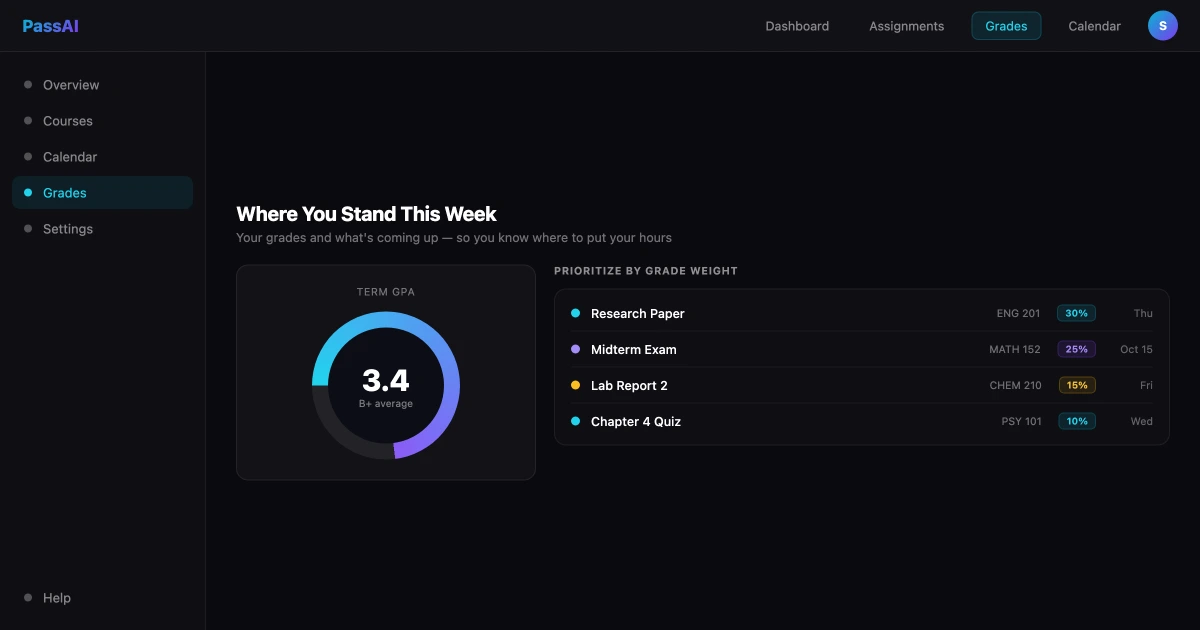
The other piece is the daily email. Each morning PassAI sends you a study plan based on what's coming up — not a generic "review your notes" reminder, but a specific list of what to work on that day based on your actual upcoming deadlines. This matters because the biggest gap in most students' study systems isn't the weekly plan — it's remembering to execute it day to day. The email removes that friction entirely.
The grade calculator runs underneath all of this. As grades come back, you enter your scores and PassAI shows your current standing in each class alongside what you need on upcoming assignments to hit your target grade. This is what makes the Sunday reset actually useful: you're not just looking at what's due, you're looking at what matters right now based on where you stand.
What to Do When Your Schedule Breaks Down
It will break down. That's not a sign the schedule failed — it's a sign you're using it. A schedule you never look at never breaks.
When it does break, don't start over. Recalibrate.
Pull up your dashboard and look at the next two weeks. Which deadlines are immovable? Which have some flex? Where are you actually behind versus where you just feel behind? That distinction matters — students frequently feel behind in courses where they're actually fine, and don't register how behind they are in courses that matter more.
If you've fallen behind in a grade-heavy course, the grade calculator is the fastest way to understand your options. Enter your current scores and see what you need on the remaining work to finish at your target. That number is either manageable or it's not — either way, knowing it changes how you prioritize the next few weeks. For a full playbook on this, see our guide on how to improve your GPA when you're already behind.
For more on building a system that recovers from disruption, see our guide on how to stay on top of assignments — specifically the "recovery protocol" section.
Frequently Asked Questions
How do you make a good study schedule for college?
Start with your actual deadlines from every syllabus — not a blank template. Identify which assignments carry the most grade weight, block fixed commitments first (class, work, sleep), then assign study blocks by priority. Review the schedule every Sunday and adjust. An AI tool like PassAI can extract all your deadlines automatically, so you're scheduling around real dates instead of guessing.
How many hours should I study per week in college?
The traditional guideline is 2–3 hours of study per hour of class time — about 30–45 hours for a 15-credit semester. But the better question is which hours matter. A 3-hour session before a 40%-weight exam beats five 1-hour sessions on a 5%-weight homework set. Weight your effort by grade impact, not just total hours logged.
What is the best app for making a study schedule in college?
PassAI is purpose-built for this. Most apps give you a blank calendar — PassAI reads your syllabus and builds your schedule from actual deadlines and grade weights. It sends a daily email every morning with exactly what to study, and the built-in grade calculator shows your current standing so you always know what to prioritize. Free to start at passai.pro with no credit card required.
Should I study the same subjects every day or rotate them?
Rotate subjects. The spacing effect shows that studying a topic in shorter sessions spread across multiple days produces better retention than cramming in one block. Study each subject 3–4 times per week in 45–90 minute focused sessions rather than one long weekly block. It feels less intense, but the material sticks significantly better over a full semester.
What should I do when my study schedule stops working?
Don't scrap it — recalibrate it. Use the Sunday reset: look at the next two weeks, check your grades, adjust your blocks. If you've fallen behind, PassAI's grade calculator shows exactly what you need on upcoming assignments to recover, so you can triage instead of panic. A schedule that survives disruption is more valuable than one that works perfectly when everything goes right.
PassAI reads your syllabus, extracts every deadline, and sends you a daily study plan.
Free to start. No credit card required.