Academic probation is a formal warning your college gives you when your GPA drops below its minimum, which is a 2.0 cumulative GPA at most schools. You're still enrolled. To get off academic probation, you raise your cumulative GPA back above that line within the terms your school allows and meet any conditions it adds, like meeting an advisor or capping your credits.
TL;DR
- At UMD, Ohio State, Florida State, East Carolina and UW–Madison, a cumulative GPA under 2.0 is the trigger.
- The GPA you need next term = (2.0 × total credits after the term − your current grade points) ÷ next term's credits.
- A 1.7 GPA on 30 credits needs a 2.60 term GPA on 15 credits to clear 2.0 in one semester.
- Some schools let you stay with a 2.5 term GPA even if you're still under 2.0 (Florida State and East Carolina both do).
- Financial aid runs on a separate federal check called SAP, with its own warning, probation and appeal.
Track every class while you're on probation. PassAI's free grade calculator turns your syllabus weights and scores into your real current grade in each class, so you see a slipping class in week 4, not in finals week.
What is academic probation?
Academic probation in college means you're below your school's minimum GPA and on a deadline to fix it. It isn't a punishment and it isn't dismissal, but it's the step before dismissal, so it counts.
Schools use a ladder, and the names vary:
- Academic warning: the first, softer step at some schools. East Carolina uses warning for your first term under 2.0 and probation for the second.
- Academic probation: you're under the line and have a set number of terms to get back above it.
- Academic suspension: you sit out for a set time, usually a semester, then reapply.
- Academic dismissal: you're removed and have to appeal or apply for readmission.
Two other things share the name and get mixed up with it. Financial aid probation is a separate status under federal rules (more below). Disciplinary probation comes from conduct, not grades, and runs through the dean of students.
What GPA puts you on academic probation?
A cumulative GPA below 2.0 puts you on academic probation at most four-year schools, but the details that decide your semester are different at every school. This table is taken from each school's own policy page:
| School | Probation trigger | How you get off it | Safety net |
|---|---|---|---|
| University of Maryland | Cumulative GPA under 2.00 | Cumulative 2.00 by the end of the probationary semester | None listed; under 2.00 may mean dismissal |
| Ohio State | Cumulative GPA under 2.0 | Cumulative 2.0 after the next semester | Your college sets a minimum term GPA to avoid dismissal |
| Florida State | Cumulative GPA under 2.0 | Cumulative 2.0; probation term must be 12–15 letter-graded hours | 2.5 term GPA = "Probation Continued," max 2 terms |
| East Carolina | 2nd straight term under 2.0 (1st is warning) | Cumulative 2.0 | 2.5 term GPA lets you keep attending |
| UW–Madison (L&S) | Cumulative or term GPA under 2.000 | Term 2.000+, cumulative 2.000+, and no Incompletes | Probation, then strict probation, then suspension |
Notice the UW–Madison row. A single bad term can put you on probation there even when your cumulative GPA is fine, and an open Incomplete keeps you on it. Read your own school's page first, because one line can change your target.
How long does academic probation last?
Academic probation usually lasts one semester before your school checks your GPA again. What happens at that check depends on the policy. At Maryland, missing a 2.00 cumulative GPA after the probationary semester can lead to dismissal. At Florida State, a 2.5 term GPA keeps you enrolled on "Academic Probation Continued" for up to two more terms.
So the real length is one to three terms, depending on how far under the line you are and your school's safety net. Your probation letter usually gives the date and the term GPA you need.
How to get off academic probation: 6 steps
You get off academic probation by hitting a specific number by a specific date. These steps turn that into a plan for the semester.
1. Find your exact number and deadline
Read your probation letter and your school's academic standing page. Write down three things: the cumulative GPA you need, the term it's due, and any minimum term GPA that keeps you enrolled if you fall short.
Where it goes wrong: students aim for "better grades" instead of a number, then find out in January they were 0.05 short.
2. Calculate the GPA you need next term
Use this formula:
Needed term GPA = (target GPA × (credits so far + next term's credits) − your current grade points) ÷ next term's credits
Your current grade points are your GPA times your credits. If you need a refresher on how those are counted, how to calculate GPA walks through it.
Where it goes wrong: using credits attempted instead of credits that count toward GPA. Pass/fail and withdrawn classes usually don't count, so check your transcript.
3. Choose your credit load with the math in front of you
More credits lower the term GPA you need, but they also give you more classes to keep up with. In the worked example below, 18 credits needs a 2.50 and 12 credits needs a 2.75. Some schools take the choice away: Florida State requires 12 to 15 letter-graded hours on probation.
If your school has grade replacement or forgiveness, retaking a class you failed is the strongest move on this list, because it removes the F's zero from your GPA instead of averaging it out.
Where it goes wrong: taking 18 credits to lower the needed GPA, then falling behind in all six classes.
4. Put every graded item on a calendar in week 1
A missed assignment is a zero, and a zero costs more than a low score you turned in, because it adds weight with no points. On probation you can't afford one. In the first week, take every syllabus and put every exam, quiz, paper and lab on one calendar with its grade weight. PassAI does this from the syllabus PDF and builds a day-by-day plan from it. A paper planner works too, if you actually fill it in.
Where it goes wrong: trusting Canvas to show everything. Instructors post assignments late, and syllabus-only deadlines never show up there. Staying on top of assignments covers the system in more detail.
5. Check every class's grade weekly, before the withdraw deadline
Once a week, enter your new scores in PassAI's free grade calculator or your own spreadsheet and look at your weighted grade in each class. The point is to catch a class sliding toward a D while you can still fix it, or drop it before the withdrawal deadline if your school counts a W as neutral for GPA (withdraw or fail: the math).
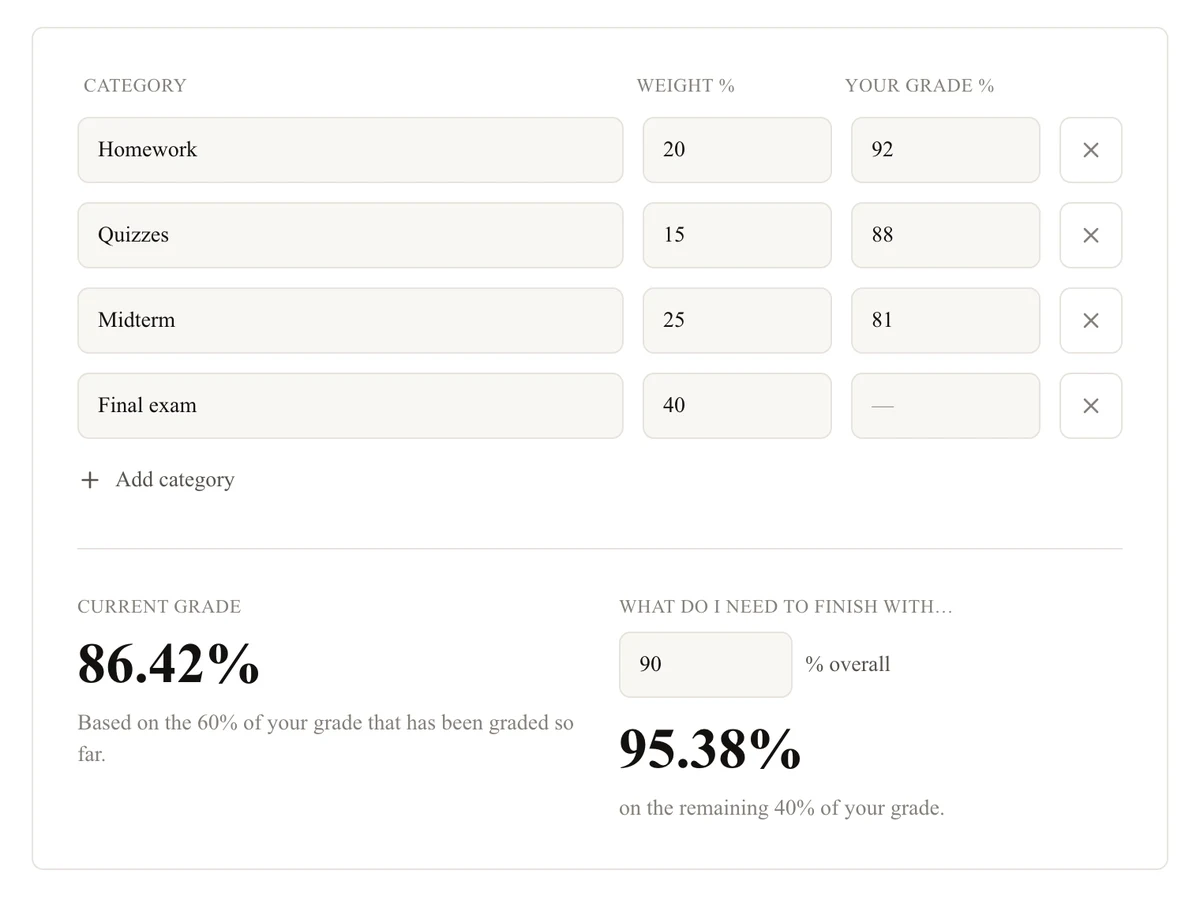
Where it goes wrong: waiting for midterm grades. By then the withdrawal deadline is often close or gone.
6. Do every condition your school attached
Many schools add conditions: an advisor meeting, a success plan, a study-skills course, a credit cap. Florida State, for example, enrolls some students in a one-credit academic success course. Do these early and keep proof, because missing a condition can count against you even if your GPA recovers.
Where it goes wrong: skipping the advisor meeting because it feels like a formality. Advisors know the appeal process, grade replacement rules and which professors take late work.
Worked example: the GPA you need to get off academic probation
Here are two students on probation, both aiming for a 2.0 cumulative GPA. The numbers are made up for illustration, and the math uses the formula from Step 2.
| Student | Now | Needed term GPA, 12 credits | 15 credits | 18 credits |
|---|---|---|---|---|
| A | 1.7 GPA, 30 credits | 2.75 | 2.60 | 2.50 |
| B | 1.5 GPA, 45 credits | 3.88 | 3.50 | 3.25 |
Student A can clear probation in one semester with mostly B's and C's. Student B would need a 3.50 after semesters that averaged 1.5, which is a jump most people can't make in one term. Their better plan is two terms: a 2.75 term GPA on 15 credits two semesters in a row lands at exactly 2.00.
Grade replacement changes Student B's math. If one of their 45 credits is a 3-credit F and their school replaces the grade when they retake it, the F's credits drop out of the GPA. Retaking that class inside a 15-credit term then cuts the needed term GPA from 3.50 to 3.10.
At Florida State or East Carolina, Student B also has a floor: a 2.5 term GPA keeps them enrolled while they climb. That's why the safety-net column in the table matters as much as the 2.0.
For the habits that make those term GPAs happen, see how to improve your GPA in college when you're behind.
What happens if you don't get off academic probation?
If you miss the target, the next step is usually academic suspension or dismissal, unless your school's safety net applies. At East Carolina, a third straight term under 2.0 means a one-semester suspension, and you reapply through admissions to come back. At Florida State, missing good standing with a term GPA under 2.5 means dismissal.
Most schools let you appeal, and the deadline is usually short, often days after grades post. A strong appeal letter answers three things in plain language:
- What happened: the specific cause, like a job, an illness or a family emergency, with dates.
- What changed: why that cause won't repeat next term.
- Your plan: the credits you'll take, the GPA you need from Step 2, and who you'll meet with.
The plan is the part committees can check, so put numbers in it. "I'll take 13 credits and need a 2.69 term GPA" carries more weight than "I'll try harder."
Does academic probation affect financial aid?
Academic probation doesn't cut your federal aid by itself, but it often happens alongside a separate federal check that can. Under 34 CFR 668.34, every school that gives federal aid must have a Satisfactory Academic Progress (SAP) policy with a minimum GPA, a minimum pace (credits passed ÷ credits attempted) and a maximum timeframe of 150% of the program length.
If you miss SAP, the federal rule allows two statuses:
- Financial aid warning: one payment period of aid, no appeal needed.
- Financial aid probation: one payment period of aid after an approved appeal, often with conditions like a reduced course load.
Pace is the trap. Withdrawing from a class can protect your GPA and still hurt your pace. Talk to your financial aid office before you drop anything.
How PassAI helps you stay off academic probation
PassAI is an AI study planner for college students. Upload your syllabus as a PDF, Word file or photo, and PassAI pulls out every assignment, quiz and exam with its grade weight, then builds a day-by-day plan, a semester calendar and a morning email of what's due. PassAI's grade calculator shows your weighted grade in each class as scores come in. It plans the work and doesn't write it for you.
New accounts get 14 days of Pro with no card, and the free plan keeps 2 classes after that.
Sources
- University of Maryland Student Success Office: Academic Probation
- Ohio State Office of Undergraduate Education: Academic Standing
- Florida State University Registrar: Academic Status and Retention
- East Carolina University Registrar: Good Standing, Warning, Probation, and Suspension FAQs
- UW–Madison L&S Academic Deans' Services: Probation
- eCFR: 34 CFR 668.34, Satisfactory academic progress
- U.S. Department of Education Student Privacy: What is FERPA?