Is it better to withdraw or fail a class? In most cases, withdraw. A W carries no grade points and stays out of your GPA, while an F counts as 0.0 for every credit of the class. For financial aid, a W and an F count the same way: attempted, not earned. Staying in the class makes more sense when a passing D is still in reach, when you've used up your school's limit on W's, or when a credit minimum (international student status, athletics, a scholarship) means you can't drop below full time.
The rest of this post shows the actual numbers, so you can check your own case before your school's withdrawal deadline. If you track your classes in PassAI, you already have each class's current grade. If not, the free grade calculator gets you there in a few minutes from your syllabus weights.
The short answer: what a W and an F each cost
A W costs you the credits and the tuition. An F costs you the credits, the tuition and GPA points. That is the whole difference for most students, and this table shows withdrawal vs failing a class in college line by line:
| Withdraw (W) | Fail (F) | |
|---|---|---|
| Grade points | None, left out of GPA | 0.0 per credit, counted in GPA |
| Transcript | Shows a W | Shows an F |
| Credits earned | 0 | 0 |
| Financial aid pace (SAP) | Counts as attempted, not earned | Counts as attempted, not earned |
| Retake needed? | Yes, if the class is required | Yes, if the class is required |
Read the last two rows twice. Students often assume a W protects their financial aid. It doesn't, any more than an F would. Its only advantage is your GPA.
One more term to know: a drop usually means leaving during add/drop week, and it leaves no record at all. After that deadline, leaving a class is a withdrawal, and the W shows up on your transcript.
How an F changes your GPA (worked example)
An F hurts because it adds credits to the bottom of the GPA fraction with zero points on top. A W adds nothing to either side, so your GPA doesn't move. The formula is in our guide on how to calculate GPA; here it is with real numbers.
Take a student with a 3.00 cumulative GPA after 30 credits (90 grade points). This term they're taking 15 credits: four 3-credit classes on track for B's (12 credits, 36 points) and one 3-credit class they're failing.
| Outcome in the failing class | Term GPA | Cumulative GPA |
|---|---|---|
| Withdraw (W) | 3.00 (12 credits) | 3.00 (126 ÷ 42) |
| Pass with a D | 2.60 (39 ÷ 15) | 2.87 (129 ÷ 45) |
| Fail (F) | 2.40 (36 ÷ 15) | 2.80 (126 ÷ 45) |
So, will one F ruin my GPA? No. But it drops this student from 3.00 to 2.80, and getting back takes about 9 credits of straight A's. At 4.0 per credit against a 3.0 target, each A credit earns back one point, and the F cost 9. The W costs nothing on this scale.
The damage also scales with what you've already completed. A first-semester freshman with no credits yet takes the full hit: the same F term is a 2.40 cumulative GPA, against 3.00 with a W. The more credits you've banked, the less one class moves the number.
Is a W worse than an F?
No. For your GPA, a W is neutral and an F is the worst grade there is. On a transcript, one W is common. An F tells a reader you stayed and didn't pass, which usually draws more questions.
A W can still cost something in two places:
- A pattern of W's. One W is noise. Several, especially in the same subject, can raise questions with graduate and professional programs.
- Caps on withdrawals. Under Texas Education Code 51.907, most undergraduates who started at a Texas public college in fall 2007 or later can drop at most six courses after the census date, across their whole degree. Once those six are used, Prairie View A&M's registrar says the student may not be allowed to drop and "will receive the grade earned." Other schools set their own limits, so search your registrar's site for "withdrawal limit."
The University of Houston points out something else to know: even when a retake replaces an F in your GPA, the original grade stays on your transcript, and graduate and professional programs may count it in their own GPA calculations.
Is it better to withdraw or fail a class for financial aid?
For financial aid, a W and an F usually land the same way, because both count as credits you attempted and didn't earn. A W only helps the GPA part of the check. So on the withdraw or fail financial aid question, the GPA is where the W wins, and nowhere else.
Federal aid depends on Satisfactory Academic Progress (SAP), which every school sets for itself within federal rules. It checks two things:
- GPA. A minimum cumulative GPA, often 2.0 for undergraduates. Here the W helps, because it stays out of the GPA and the F doesn't.
- Pace. Credits earned divided by credits attempted. The Federal Student Aid Handbook says a school's SAP policy can't leave out courses where a student stayed past add/drop and got a W. Miami University puts it plainly: grades of W or F count "as hours attempted but not earned," and it requires completing at least 67% of attempted credits.
With the same example student: 30 of 30 credits earned before this term, then 12 of 15 earned this term. Pace is 42 ÷ 45 = 93% whether the fifth class ends in a W or an F. One class rarely breaks pace. Several W's or F's across a few terms can.
Two aid rules can matter more than the grade itself:
- Dropping below full time. Some grants and scholarships depend on your credit load. Ask your financial aid office what changes if you go from 15 to 12 credits (or 12 to 9) before you submit the withdrawal.
- Withdrawing from every class. That counts as leaving school, and it triggers a Return of Title IV Funds calculation. Under federal rules, you earn your aid in proportion to the term you've completed, up to the 60% point; after 60%, you've earned all of it. Dropping one class out of five isn't this.
Should you withdraw from a class on academic probation?
If you're on academic probation, a W is usually worth more than it is to anyone else, because the F can decide whether you get off probation at all. Run the numbers before you decide.
Take a student on probation with a 1.90 GPA after 30 credits (57 grade points). This term: 12 credits on track for 2.5 (30 points) and one 3-credit class headed for an F. Their school requires a 2.0 cumulative to get off probation.
| Outcome in the failing class | Term GPA | Cumulative GPA | Off probation? |
|---|---|---|---|
| Withdraw (W) | 2.50 | 2.07 (87 ÷ 42) | Yes |
| Pass with a D | 2.20 | 2.00 (90 ÷ 45) | Just barely |
| Fail (F) | 2.00 | 1.93 (87 ÷ 45) | No |
Same student, same other four classes. The W gets them off probation, the D gets them there with no margin at all, and the F keeps them on it for another term.
Check the terms of your probation first, though. Some schools set conditions on the probation term itself. Florida State, for one, requires students on probation to enroll in 12 to 15 letter-graded hours, so ask your advisor whether a W that takes you below 12 breaks the terms. Our academic probation guide has the needed-GPA formula and five schools' real policies.
Check what you need on the final before you decide
Before you withdraw, find out what's still possible. If a C is out of reach but a D isn't, your decision changes. PassAI's free final grade calculator shows the score you need on the final for every letter grade at once.
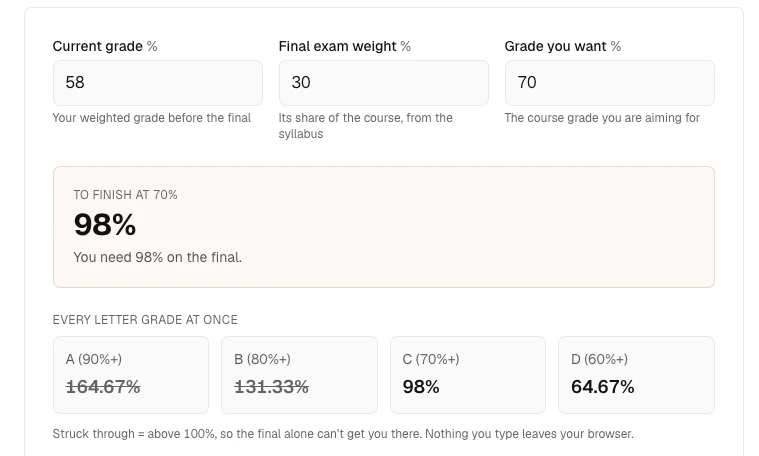
Here a student sits at 58% with a final worth 30%. A C (70%) needs a 98% on the final, which isn't a real plan. A D (60%) needs 64.67%, which is. That student isn't choosing between a W and an F. They're choosing between a W and a likely D, and in the probation example above, a D was the difference between staying on probation and clearing it.
If you're mid-semester and the final is still far off, start one step earlier. Put your syllabus weights and scores into the grade calculator to get your real current grade, since the percentage in Canvas is often off when weights aren't set up (here's why).
When staying in the class beats withdrawing
Withdrawing is the default, but there are four cases where finishing the class, even with a low grade, is the better call.
1. A D is reachable and it counts. A D usually counts as passing, so it earns the credits and helps your pace. Whether it satisfies a requirement depends on your catalog, since many majors want a C or better in major courses. If the final grade calculator says a D is realistic, stay and fight for it.
2. Your school replaces failed grades, and you've used up your W's. With grade replacement, an F followed by a B on the retake ends up close to where a W followed by a B would. In the first example, a retaken B that replaces the F brings the student back to 3.00 (135 ÷ 45). Without replacement, the F and the B are both averaged in: 135 ÷ 48 = 2.81. Rules vary a lot:
- UCF allows grade forgiveness only for courses where the first grade was a C- or lower, and you apply by a deadline in the term you retake it.
- The University of Houston limits it to grades of D+ or lower from your first year, retaken within twelve months, and the original grade stays on your transcript.
If you're at your W limit and your school replaces grades, finishing and retaking may be your only route anyway.
3. You need to stay full time. International students on an F-1 visa must keep a full course of study, and a reduced course load needs your DSO's approval, entered in SEVIS, before you drop. Athletes and some scholarship holders have credit minimums of their own. Talk to the international office, compliance office or scholarship office before you file.
4. The deadline has passed. After your school's withdrawal deadline, you usually can't take a W without a documented medical or family emergency. At that point the question is no longer withdraw or fail; it's how many points you can still save.
Two other options are worth one email to your advisor before you decide. An Incomplete gives you extra time to finish, but schools usually grant it only for a documented reason when most of the work is done, and you should ask what it turns into if you don't finish by the deadline. Pass/fail (or credit/no credit) keeps a passing grade out of your GPA at many schools, but the switch deadline is often earlier than the withdrawal deadline, and some majors won't accept a pass for required courses.
Should I withdraw from a class? A 3-question check
Answer these three in order, ideally the week before your school's deadline:
- What grade can I still get? Use your current grade and the final's weight. If a C is reachable, stay. If only a D is, see the cases above. If nothing passing is, keep going to question 2.
- What does a W cost me here? Check your school's W limit, your probation terms, and with the financial aid office, what changes if you drop below your current credit load.
- Will I have to retake it? If it's required for your degree, you'll take it again either way. Withdrawing now keeps the failed attempt out of your GPA and frees up hours for your other classes this week.
Where it goes wrong
- Stopping going instead of withdrawing. If you stop attending without filing anything, the registrar usually records the grade you earn, which at that point is an F.
- Assuming a W is free for aid. It isn't. It counts as attempted credits under SAP, the same as an F.
- Missing the date. The withdrawal deadline usually comes well before finals, and it doesn't move. Look yours up on the academic calendar today, not after the next exam.
- Withdrawing without a plan for the other classes. The hours you free up only help if they go to classes you can still save. Our guide to raising your GPA in college covers where to put that time.
Don't end up here next semester
Most withdraw-or-fail decisions start in week 4, when one class slips and nobody notices until midterms. PassAI reads your syllabus, pulls every assignment, exam and grade weight, builds a day-by-day study plan, and tracks your real grade in each class, so a slipping class shows up while it's still fixable. It plans and tracks; it doesn't write your assignments.
Sources
- Federal Student Aid, Staying Eligible: Satisfactory Academic Progress
- Federal Student Aid Handbook 2025–2026, Vol. 1, Ch. 1: School-Determined Requirements (SAP)
- Federal Student Aid Handbook 2025–2026, Vol. 5, Ch. 1: Withdrawals and the Return of Title IV Funds
- Miami University, Satisfactory Academic Progress
- Prairie View A&M University, Six-Drop Rule per TEC 51.907
- University of Houston, Grade Exclusion Policy
- University of Central Florida, Grade Forgiveness
- Study in the States (DHS), Understanding Reduced Course Load for F-1 and M-1 Students