How do you catch up in college when you fall behind? Rank every class by the points you can still earn, not by how much you missed. List each missing and upcoming assignment with its grade weight, check which missing work your professor still accepts, and email each professor once. Then spend most of your hours on current work and finals, because three weeks before finals that's usually 90% or more of the points still in play.
That last number surprises most people who are behind. In the 4-class example below, the missing work you could recover adds up to 8 to 13 points, and the work still ahead adds up to 137. Catching up is mostly about not falling further behind, plus a short, chosen list of old work worth finishing.
If your syllabi are already in PassAI, you have the full list with weights. If not, the steps below take about 45 minutes with a pen and your syllabi.
The short answer: triage by points still available
Figuring out how to catch up in college classes comes down to one number per class: points still available. It's the only fair way to decide what to do first when you're behind in all your classes. For each class, add two numbers: the missing work you can still turn in for credit, and the weight of everything not graded yet (assignments still to come, quizzes, the final). The class with the biggest total gets your first hours.
This beats the two instincts people usually follow. Working through the backlog from oldest to newest feels responsible, but the oldest items are often the ones that no longer count. Working on whatever is due next keeps you busy but never touches the late lab report that's worth more than a week of homework.
Where it goes wrong: treating every missing item as equal. A 1% reading quiz and a 10% lab report look the same on a to-do list. They're not the same on your transcript.
Step 1: List everything you owe (worked example)
Open each syllabus and your Canvas (or Blackboard, Moodle) grades page side by side, and write one row per class. You need the missing work, its weight, the late-work rule, and the weight still ahead. This is the whole "how to catch up on schoolwork" problem in one table, and it's usually 45 minutes of work.
Here's a made-up but typical fall semester for a student who's behind in 4 classes:
| Class | Missing work (weight) | Late policy in the syllabus | Missing points still available | Weight still ahead | Total in play |
|---|---|---|---|---|---|
| Biology | Lab report 3 (10%) | Accepted until the last day of class, max 80% | 8 | 45 (quizzes 10, lab practical 10, final 25) | 53 |
| Statistics | Problem sets 6 and 7 (4%) | 10% off per day, closes after 5 days | 0 | 35 (problem set 8: 5, final 30) | 35 |
| English Comp | Essay 2 draft (5%) | "No late work accepted" | 0 to 5, if you ask | 30 (final essay 20, portfolio 10) | 30–35 |
| Psychology | 3 reading quizzes (3%) | Quizzes close on their due date | 0 | 27 (2 quizzes 2, final 25) | 27 |
So the order is Biology, then Statistics, then English, then Psychology. The single backlog item worth real time is the Biology lab report.
Here's why it matters. Say the student has earned 37 of the 55 Biology points graded so far (the missing lab report counts as a zero). If they score 85% on everything still ahead, that's 38.25 more points, for a 75.25: a C. If they also turn in the lab report late and it scores 85% before the 80% cap, that adds 6.8 points, for an 82.05: a B-minus. One overdue assignment is the difference between a C and a B-minus. The three Psychology quizzes are worth nothing now, so skip them without guilt.
Where it goes wrong: skipping the weights because the list feels like enough. Without weights, the old quizzes and the lab report sit side by side, and you'll do the quick ones first because finishing them feels good.
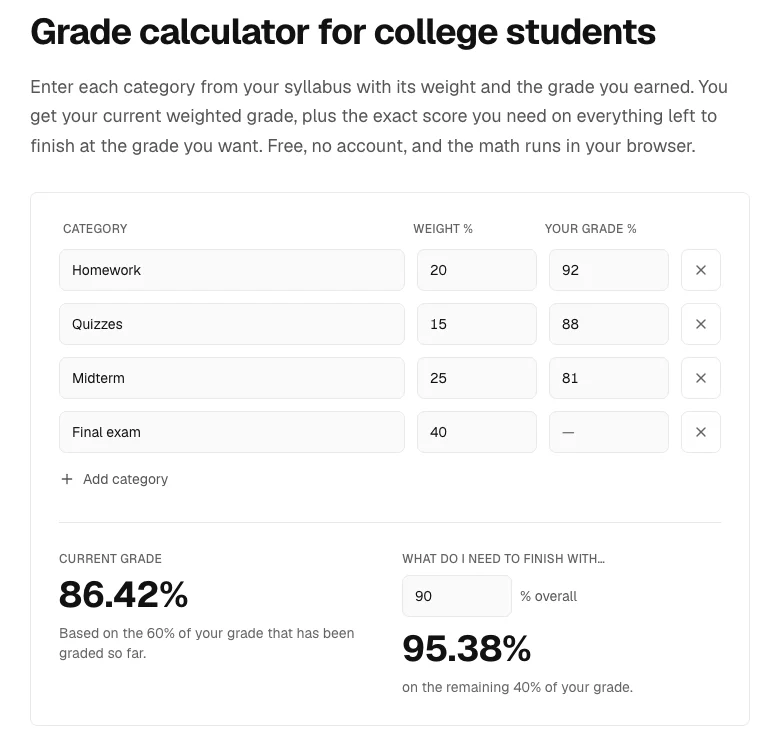
PassAI's syllabus reader does this step for you: upload each syllabus (PDF, Word, a photo or pasted text) and it pulls every assignment, exam and quiz with its grade weight into one list, and PassAI's grade calculator shows where each class stands right now, plus the score you need on everything left to finish at the grade you want. The calculator is free and needs no account.
Step 2: Read each late-work policy
The late policy decides which missing work is still worth doing, and it's in the syllabus, usually under "Late work," "Make-up work" or "Course policies." Read it for each class before you touch the backlog, because the rules vary a lot from class to class.
Three real patterns you'll see:
- Flex days, then a cap. A sample policy from Carnegie Mellon's Eberly Center gives students two flex days with no penalty, then caps work submitted within 24 hours at 80% and refuses anything later.
- A daily deduction. "10% off per day late" is common. On a 5-day window, a problem set that's 3 days late can still earn 70% of its value, and one that's 6 days late earns nothing.
- "No late work." It often has more give than it says. A teaching center at Eastern Connecticut State University notes that most faculty accept some late work under certain conditions, even when the syllabus says they don't. You find out by asking.
Mark each missing item as "still counts," "ask" or "gone." Only the first two get time this week.
Where it goes wrong: assuming a closed Canvas submission means a closed door. The Canvas lock is a setting. The professor can reopen it, but only if you ask.
Step 3: Email the professor (template)
Send one short email per class where something is missing, before your next class meeting. Professors get a lot of vague "I'm sorry I'm behind" emails. A specific one with a date gets a faster and more generous answer. The Eastern Connecticut sample policies ask students to explain why they need an extension and propose a new deadline, so give them both up front.
Copy this and fill it in:
Subject: [Course + section] – late [assignment name]
Hi Professor [Name], I'm behind in [course] and haven't submitted [assignment] (due [date]). I can turn it in by [date, 2–4 days out]. Is late credit still possible? If not, what should I focus on to finish the class strongest?
Thank you, [Full name], [section/meeting time]
Keep the reason to one clause if you give one ("I was sick the week of the 3rd"). The ask matters more than the story. If the class has office hours this week, go in person with the same 3 facts; it's harder to say no to someone who showed up.
Where it goes wrong: waiting until the work is done to email. By then the window may have closed. Email first, then do the work by the date you named.
Step 4: A 14-day catch-up plan
Two weeks gets you from behind to caught up on what still counts, with a week left for finals. The rule for every day: current work first, then one backlog item, then stop. Plan 2 to 4 focused hours a day on top of class, and keep sleep at 7 or more hours, which is what the American Academy of Sleep Medicine recommends for adults. An all-nighter on the backlog costs you the next day's lecture, and that just creates new backlog.
Here's the 14-day plan for the example student:
| Days | Focus | Why this order |
|---|---|---|
| 1 | 45-minute audit (Step 1), late policies (Step 2), all emails sent (Step 3) | Everything else depends on knowing what still counts |
| 2–3 | Biology lab report, 2 hours a day; current homework after | Biggest missing item still worth points |
| 4 | Statistics problem set 8; ask a classmate for notes from missed lectures | 5% due soon; borrowed notes are faster than rewatching every lecture |
| 5–6 | English final essay outline; office hours or the writing center for feedback | 20% of the grade; feedback early is worth more than feedback late |
| 7 | Light day: catch up on readings for classes this week only | A rest day keeps days 8–14 from collapsing |
| 8–10 | Turn in the lab report; Statistics final review starts (30%) | The final is the biggest single item left in Statistics |
| 11–12 | English final essay full draft; Psychology review sheet | Draft early so there's time to revise |
| 13–14 | Biology lab practical prep; build your finals schedule | Hands off to finals week with nothing overdue |
If a holiday falls inside your two weeks (Thanksgiving does for most US schools), mark those days as light days instead of pretending you'll work 6 hours on them. A plan that assumes your best day every day breaks by day 3.
When you get to finals, PassAI's exam study plan generator turns your exam dates into a free day-by-day schedule, and our guide on how to study for final exams covers how to split the hours across finals.
Where it goes wrong: filling every slot with backlog. The day you skip current homework to finish old work, you've made a new missing assignment.
When to drop a class instead
Drop a class only when your best possible grade is below what you need and your school's withdrawal deadline hasn't passed yet. Check the best case with one sum: points earned so far plus every point still ahead.
In the example, the student earned 40 of the 73 Psychology points graded so far. Even 100% on everything left adds 27, for a 67: a D-plus. If the class needs a C for the major, no amount of catching up gets there this term. That's the case where a W, an Incomplete or a retake belongs in the conversation, and our breakdown of whether it's better to withdraw or fail a class has the GPA and financial aid math. For a quick check of your own numbers, PassAI's final grade calculator shows the score you'd need on the final.
Two warnings. Late November is after the withdrawal deadline at many schools, so look yours up on the academic calendar today. And a drop that takes you below full time can affect financial aid or visa status, so ask your advisor before you file.
Where it goes wrong: dropping the class that's stressing you most instead of the one whose math doesn't work. Stress isn't the test. The best-case grade is.
Don't end up behind again in January
Falling behind in college almost always starts the same way: deadlines live in five places, and nobody adds up the weights until midterms. The fix is a single list with every graded item and its weight from week 1, and a weekly check of which class is slipping.
Our guide to staying on top of assignments has the setup, and prioritizing assignments by grade weight explains the sorting rule this post used. PassAI does both from your syllabus: it builds a day-by-day study plan, sends a morning email with what's due, and re-checks your Canvas or Moodle calendar every day so new deadlines show up on their own. It plans the work; it doesn't do your assignments.