Procrastination in college doesn't feel like a choice. It feels like a wall.
You know the paper is due Friday. You want to start. You open your laptop, stare at the blank document for a while, then somehow it's two hours later and you've reorganized your downloads folder and watched four videos about something unrelated. The work didn't get smaller. The deadline got closer. And the guilt made the whole thing harder to start tomorrow.
Here's the part most advice gets wrong: you don't fix this with more discipline. Procrastination isn't a willpower deficit. It's two specific, fixable problems wearing a trench coat — you can't see your whole workload clearly, and you don't know how to start the task in front of you. Solve those two and the wall mostly disappears.
Quick answer: To stop procrastinating in college, treat it as a visibility and starting problem rather than a willpower one. Pull every deadline from every syllabus into a single view so the work stops feeling vague, then shrink the first step of any task until it takes two minutes to begin. Use grade weight to decide what to start first, and set up a daily prompt so you're not re-deciding every morning. PassAI automates the visibility half — it reads your syllabus, lays out every deadline and grade weight, and emails you a short daily plan — so the only thing left to do is start.
Procrastination Isn't a Willpower Problem
The most useful thing you can do is stop believing the story that you procrastinate because you're lazy or undisciplined. It's not just kinder — it's more accurate, and it points you at fixes that actually work.
Researchers who study procrastination describe it as an emotion-regulation problem, not a time-management one. You don't avoid the task because you don't care about your grade. You avoid it because the task carries some discomfort — it's boring, it's confusing, you're not sure you'll do it well, you don't know where to start — and avoiding it gives you immediate relief from that discomfort. The relief is the reward. Your brain learns the pattern fast.
That's why "just try harder" rarely sticks. Willpower fights the symptom. The discomfort of starting is the cause. And it's extremely common: reviews of the research, including Piers Steel's widely cited 2007 analysis, estimate that 80–95% of college students procrastinate to some degree, with roughly half doing it chronically enough to hurt their grades.
So if you procrastinate, you're not broken and you're not the exception. You're in the overwhelming majority — which means the problem is structural, and structural problems have structural solutions.
The Two Real Causes: You Can't See It, and You Can't Start It
Almost every procrastination spiral traces back to one of two failures. Name which one you're hitting and the fix gets obvious.
1. The visibility problem. When your workload lives in five different places — three Canvas pages, a syllabus PDF you opened once in week one, something a professor said out loud in lecture — your brain can't hold an accurate picture of it. Vague threats are easy to avoid. A blurry "I have stuff due eventually" produces zero urgency until it suddenly becomes a five-alarm fire the night before. You're not avoiding the work; you genuinely can't see it clearly enough to act on it.
2. The starting problem. Even when you know exactly what's due, "write the 8-page paper" is not a thing you can do. It's a thing you can be intimidated by. The task as stated is too big, too undefined, and too tied up with fear of doing it badly. So you wait for a version of yourself with more energy and clarity to show up. That version never arrives on schedule.
Most students try to brute-force past both of these with motivation. It doesn't work because motivation is the wrong tool. The seven methods below attack visibility and starting directly.

How to Stop Procrastinating in College: 7 Methods That Actually Work
1. Make your entire workload visible in one place
This is the highest-leverage move, and it's the one almost no one does properly. Before you can stop avoiding the work, you have to be able to see all of it — every assignment, exam, and quiz, across every class, with due dates and grade weights, in a single view.
Doing this by hand means reading 5 syllabi and copying 15–30 items each into a calendar. It takes two or three hours, which is itself a task you'll procrastinate on. So most students never build the complete picture, and they pay for it all semester in surprise deadlines.
The faster path is to upload your syllabus to an AI tool. PassAI reads each PDF and extracts every deadline and grade weight automatically, usually in under 60 seconds per syllabus. Suddenly the work is concrete instead of vague — and concrete work is dramatically harder to avoid than a fuzzy sense of dread.
2. Shrink the first step until it's stupid-easy
The single most effective tactic against the starting problem is the two-minute rule: redefine the task until its first step takes two minutes or less, then do only that step.
"Study for the chem exam" becomes "open the study guide and read question one." "Write the essay" becomes "open a doc and type the title." "Start the problem set" becomes "copy problem one onto a piece of paper." These sound trivial — that's the point. You're not trying to do the work yet. You're trying to break the inertia of starting, which is where the discomfort lives. Once you're moving, momentum does most of the rest.
The reframe that makes this work
Your goal for the session is not "finish the paper." It's "start the paper for two minutes." You're allowed to stop after two minutes — you almost never will, but giving yourself permission to is what gets you past the wall.
3. Use grade weight to break decision paralysis
A surprising amount of procrastination is just decision fatigue in disguise. You sit down, face six possible things to do, can't decide which matters most, and the indecision itself becomes a reason to do none of them.
Grade weight cuts through this instantly. The task to start is almost always the one with the highest grade weight and the nearest deadline — not the one that feels most urgent because someone mentioned it last. A final paper worth 25% beats a discussion post worth 2%, even if the discussion post is due sooner. When you rank by impact, "what should I do right now" stops being a question you have to agonize over.
4. Time-box with a start ritual, not just a deadline
Deadlines create pressure, but pressure that only spikes at the last minute is what causes all-nighters, not consistent work. A better trigger is a start ritual: a small, repeatable cue that tells your brain it's time to begin.
Pick a fixed block — say, 7:00pm at the library desk, headphones on, phone in your bag — and attach it to a study schedule built from your real deadlines. The ritual matters more than the duration. You're training your brain to associate a specific cue with starting, so beginning becomes automatic instead of a negotiation you lose every night.
5. Use "if-then" plans to pre-decide
One of the most reliable findings in behavioral psychology is the power of implementation intentions — simple "if-then" plans that decide your behavior in advance. Instead of "I'll study more this week," you write: "If it's 6pm on Tuesday, then I review biology for 45 minutes at the library."
Why it works: in the moment, your willpower is depleted and the discomfort of starting is loud. If you've already decided exactly when, where, and what, there's no decision left to lose. You're just executing a plan made by a calmer version of you. Pre-deciding removes the exact moment where procrastination usually wins.
6. Close open loops before they tax you
Ever notice that an unstarted assignment nags at you all day — but the moment you start it, the mental noise quiets down? That's the Zeigarnik effect: unfinished tasks occupy your attention in a way finished ones don't.
The practical takeaway is counterintuitive. The fastest way to stop a task from draining you mentally isn't to finish it — it's to start it, even badly. A paper you've written one messy paragraph of stops haunting you the way a completely blank one does. Use this: when something is looming, do a two-minute opening pass just to convert it from "haven't started" to "in progress." The relief is real and it makes returning to the task easier.
7. Build a daily prompt so you stop re-deciding
The biggest hidden cost of procrastination isn't any single avoided task — it's the energy you burn every morning re-deciding what to do, and losing that decision. Remove the decision and you remove most of the leak.
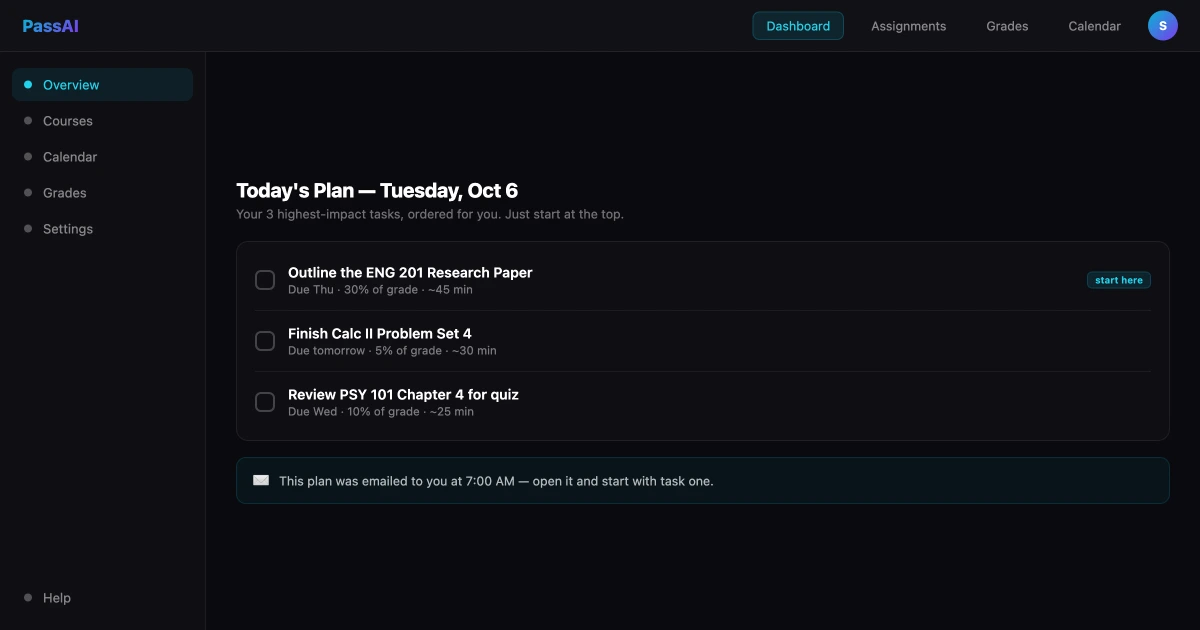
This is the part worth automating. PassAI sends one short email each morning with exactly what to work on that day, ordered by what's coming up and what carries the most grade weight. You don't open five tabs, you don't rebuild a mental to-do list, you don't negotiate with yourself about priorities. You read three lines and start. For a deeper system around this, see how to stay on top of assignments in college.
Why "Just Use a Planner" Doesn't Fix Procrastination
Most advice ends at "get organized" and points you at a tool. The problem is that the popular tools leave the hardest part — the part you actually procrastinate on — entirely up to you.
Notion is a blank canvas. It can build a beautiful student dashboard, but you have to build it, enter every deadline by hand, and maintain it. For a chronic procrastinator, "set up your Notion system" is just one more intimidating, undefined task to avoid. The setup friction is the failure point.
Canvas only shows what your professors choose to publish in it. Assignments that live only on the syllabus, or get announced in class, never appear — so the picture it gives you is incomplete, and incomplete visibility is exactly what feeds procrastination. (We dug into this in why Canvas isn't enough.)
Google Calendar and paper planners are only as complete as what you remember to put in them. They don't read your syllabus, they don't know grade weights, and they require the manual entry you'll skip.
None of these tools are bad. They just don't remove the friction that causes procrastination — they often add to it. The thing that helps is a tool that does the visibility and prioritization work for you, so the only thing left is to start.
How PassAI Removes the Friction That Causes Procrastination
PassAI is built around the two real causes. It attacks visibility and starting directly, instead of asking you to supply more willpower.
You upload your syllabus PDFs and the AI reads every page — tables, footnotes, "see week 9" references — and extracts every assignment, exam, and quiz with grade weights attached. Recurring items get expanded into individual dated entries. In about ten minutes you go from five scattered syllabi to one complete, accurate semester map. The visibility problem is solved without the two hours of manual entry that usually kills it.
Then each morning, PassAI emails you a short, specific plan: here's what to work on today, ordered by deadline and grade weight. That single email kills the daily re-decision that drains most students — you're not choosing what matters, you're just starting on it.
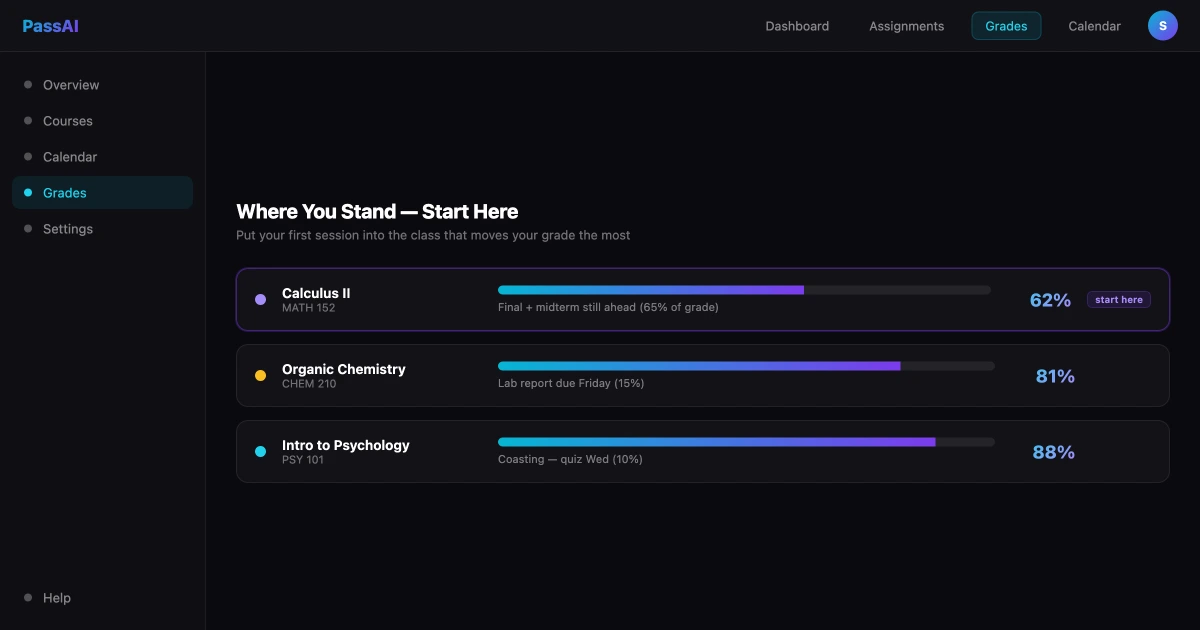
The grade calculator runs underneath everything. Enter your scores as they come back and PassAI shows where you stand in each class and what you need on what's left. That's what makes prioritization concrete: when you can see that your biology final is worth 30% and you're sitting on a B-minus, the decision about what to start tonight makes itself.
It's free to start, with no credit card required. It will not write your papers or do your work for you — that's not the point. It removes the friction in front of the work so that you starting becomes the easy default instead of the daily battle.
When You're Already Behind
Procrastination compounds. One avoided assignment becomes a pile, and the pile becomes its own reason to keep avoiding — it's too big to face, so you don't.
The way out is triage, not heroics. Don't try to catch up on everything at once and don't start with whatever feels loudest. Start with the single task that moves your grade the most, which is almost always the highest-weight item with the nearest deadline.
This is where seeing the numbers matters. PassAI's grade calculator turns a paralyzing pile into a ranked, finite list: it shows what you need on remaining work in each class, so you know which late assignment is actually worth doing first and which one barely moves your grade. Starting on the one task that matters most beats anxiously doing a little of everything — and it gives you the early win that makes the next task easier. For the full playbook, see how to improve your GPA when you're already behind.
You don't need to become a different person to stop procrastinating. You need the work to be visible and the first step to be small. Set those two things up once, and starting stops being the hardest part of your day.
Frequently Asked Questions
How do I stop procrastinating in college?
Stop treating it as a willpower problem. Procrastination is mostly caused by two things: not being able to see your whole workload (so everything feels vague and far away) and not knowing how to start a task (so you avoid it). Fix both: pull every deadline into one view so the work is concrete, then shrink the first step of any task until it takes two minutes to begin. A tool like PassAI handles the visibility half automatically — it reads your syllabus, lays out every deadline with grade weights, and emails you a short daily plan so you don't have to decide what to do each morning.
Why do I procrastinate so much in college specifically?
College removes the external structure high school gave you. No one checks your homework nightly, deadlines are weeks out instead of days, and a single syllabus drop on day one is the only time most of your semester is laid out for you. That combination — low immediate accountability plus high uncertainty about what's actually due — is exactly the environment procrastination thrives in. It's situational, not a character flaw.
Is procrastination a sign of laziness?
No. Research frames procrastination as an emotion-regulation problem, not a motivation or laziness problem — you avoid a task to escape the discomfort it brings (boredom, anxiety, not knowing where to start), and the short-term relief reinforces the avoidance. That's why "just try harder" rarely works. The fix is reducing the discomfort of starting, not summoning more willpower.
What is the 2-minute rule for procrastination?
Shrink any task until the first step takes two minutes or less, then do only that. "Write the essay" becomes "open the doc and write the title." "Study for the exam" becomes "read the first practice question." The point isn't the two minutes of work — it's that starting is the hardest part, and once you're in motion, continuing is far easier than beginning.
How many college students procrastinate?
The large majority. Reviews of the research, including Piers Steel's widely cited 2007 analysis, estimate that 80–95% of college students procrastinate to some degree and roughly half do so chronically enough to hurt their grades or well-being. If you procrastinate, you are squarely in the norm — which also means the problem is structural and solvable, not unique to you.
Do planners and apps actually help with procrastination?
A blank planner or calendar usually doesn't, because the hardest part — figuring out what's due, what matters most, and what to do first — is left to you, and that decision work is itself something you'll procrastinate on. Tools help when they remove that friction: when they collect your deadlines for you, rank them by grade weight, and tell you specifically what to start today. That's the difference between an empty Notion template and a tool like PassAI that builds the plan from your syllabus.
How do I stop procrastinating when I'm already behind?
Don't try to catch up on everything at once — triage. Figure out which classes have the most grade weight still ahead of you, and put your first session there. PassAI's grade calculator shows exactly what you need on remaining assignments in each class, which turns a paralyzing pile of late work into a ranked, finite list. Starting on the one task that moves your grade most beats anxiously doing a little of everything.
PassAI reads your syllabus, lays out every deadline, and emails you a short daily plan.
The work becomes visible — all that's left is to start. Free, no credit card.