You get the syllabus in week one, skim it for the textbook name and the professor's office hours, and close the tab. That's the version of "reading a syllabus" most students actually do — and it's also why the 20%-worth final project buried on page nine shows up as a surprise in November.
The syllabus isn't a formality. It's the single document that tells you exactly what's going to happen to your grade for the next four months. Reading it properly takes fifteen minutes. Not reading it properly costs you a lot more than that later.
Quick answer: To read a syllabus properly, pull out three things on a single pass — the grade breakdown (what percentage each category is worth), the assignment schedule (every graded item and its due date), and the policies that actually affect your grade (late work, attendance, participation). Do this for every class in week one, and you'll have your whole semester mapped before anyone else has finished skimming the first page. PassAI automates this — upload the PDF and it extracts every deadline and weight in under 60 seconds.
Why Skimming a Syllabus Fails
Here's the pattern: week one, you open five or six PDFs, glance at each one for under a minute, and move on. You catch the textbook title and maybe the exam dates if they're near the top. What you don't catch:
- The participation grade that's actually worth 15%, graded on a rubric you never read.
- The paper due in week 10 that's only mentioned once, in a table on page 7.
- The late policy that drops a full letter grade per day — which you find out about the first time you're late.
- The fact that the "final exam" is cumulative and worth 30%, not just covering the last unit.
None of this is because the professor was trying to hide it. It's because a syllabus is built to be complete, not to be skimmable. It's part legal document, part policy manual, part schedule — and the part you actually need for planning (dates and weights) is usually spread across several sections, not summarized anywhere.
The fix isn't reading faster. It's reading with a specific extraction job in mind, instead of just reading start to finish and hoping things stick.
The Three Things to Pull Out of Every Syllabus
Every syllabus, no matter how it's formatted, has three sections that actually change how you should spend your semester. Everything else is useful context, but these are the ones worth a deliberate, careful pass.
1. The grade breakdown. This is usually a short list or table near the top: "Homework 20%, Midterm 25%, Final 30%, Participation 10%, Quizzes 15%" or similar. This is the single most important paragraph in the entire document, because it tells you where your time is actually worth spending. A lot of students study hardest for the thing that's due soonest, not the thing that's worth the most — the grade breakdown is what corrects that.
2. The assignment and exam schedule. This is every graded item with a date attached: papers, projects, quizzes, exams, presentations. It might be a clean table, a week-by-week list, or scattered across a "course schedule" section near the back. Pull every single one out, even the small ones — a 2% quiz doesn't matter much alone, but ten of them across the semester add up to a fifth of your grade.
3. The policies that touch your grade. Not every policy matters equally. Focus on: late work (how many points per day, is there a grace period), attendance (is it graded or just expected), and academic integrity specifics for that class (some professors have unusual rules about collaboration or AI tool use). Office hours, contact info, and the university's standard boilerplate are useful but don't change your week-to-week plan.
The 15-minute test
If you can't answer these three questions after reading a syllabus, you haven't actually read it yet: What percentage is the single biggest chunk of my grade? What's the next three things due, and when? What happens if I turn something in late? Everything else is secondary.
Where Professors Hide the Stuff That Matters
"Hide" is a strong word — nothing here is intentionally sneaky — but there are a few predictable spots where important information sits outside the obvious places:
- Footnotes under tables. A grading table will list "Exams: 40%" and a tiny footnote below explains the final is cumulative, or that the lowest quiz score is dropped. Easy to miss if you only read the table itself.
- "See course schedule" references. Some syllabi list a grade breakdown up top but push actual dates to a separate schedule — sometimes a different document entirely, posted on Canvas or Blackboard instead of in the PDF. If your syllabus says "see schedule," go find that schedule before you consider yourself done.
- Recurring items described once. "Reading responses due every Tuesday" might appear as a single line, not fifteen individual dates. If you don't do the math yourself, you won't realize that's 15 separate grades adding up to a meaningful chunk of your final grade.
- Mid-paragraph policy changes. Late penalties, extra credit opportunities, and attendance rules sometimes show up inside a paragraph of prose rather than a bullet list, which makes them easy to skim past.
- The last page. A surprising number of syllabi save the actual week-by-week schedule for the very end, after several pages of policy and course description. If you stop reading before the last page, you may have missed the one section you actually needed.
This is the same problem we cover from the tooling side in how to upload your syllabus to AI — the reason automated extraction is useful isn't that reading is hard, it's that these details are genuinely scattered by design, and a careful human read has to work against that structure every time.
A Simple Read-Through Method
Here's a straightforward way to do the first read, in order:
- Find the grade breakdown first, even if it's not at the top. Write down every category and its percentage before you read anything else.
- Scan for the assignment/exam schedule next. List every graded item with its date — including "TBD" ones, so you remember to check back.
- Expand any recurring items. If it says "quiz every Friday," count the Fridays in the semester and note that it's actually that many individual grades.
- Read the late and attendance policy once, carefully. This is the one policy section worth full attention, since it directly affects your grade if you're ever running behind.
- Skim the rest — course description, required materials, academic integrity boilerplate, contact info. Useful, but you don't need to memorize it.
Do this for each class the first week, and you'll have pulled every real planning detail out of the document in about fifteen to twenty minutes per class. That's under two hours for a full five-class semester — a fraction of the time you'll spend later hunting for a due date you should have caught the first time.
Turning a Syllabus Read Into an Actual Plan
Reading it carefully is only step one. The reason this matters is what you do with the information afterward — and this is where most students' good intentions in week one quietly fall apart.
The typical path: you read the syllabus carefully, feel organized, and then... nothing happens with that information. It's not written down anywhere central. Three weeks later you're back inside the PDF trying to remember when the midterm is, because the only place that date lived was a document you read once.
The fix is getting every date and weight out of the PDF and into one place you'll actually look at — ideally something that also tells you what matters most, not just what's due next. That's the difference between a calendar (which only shows when) and a real plan (which also shows how much it counts), a distinction we go into more in why Canvas isn't enough — Canvas only shows what a professor chooses to publish there, and plenty of syllabus detail never makes it in.
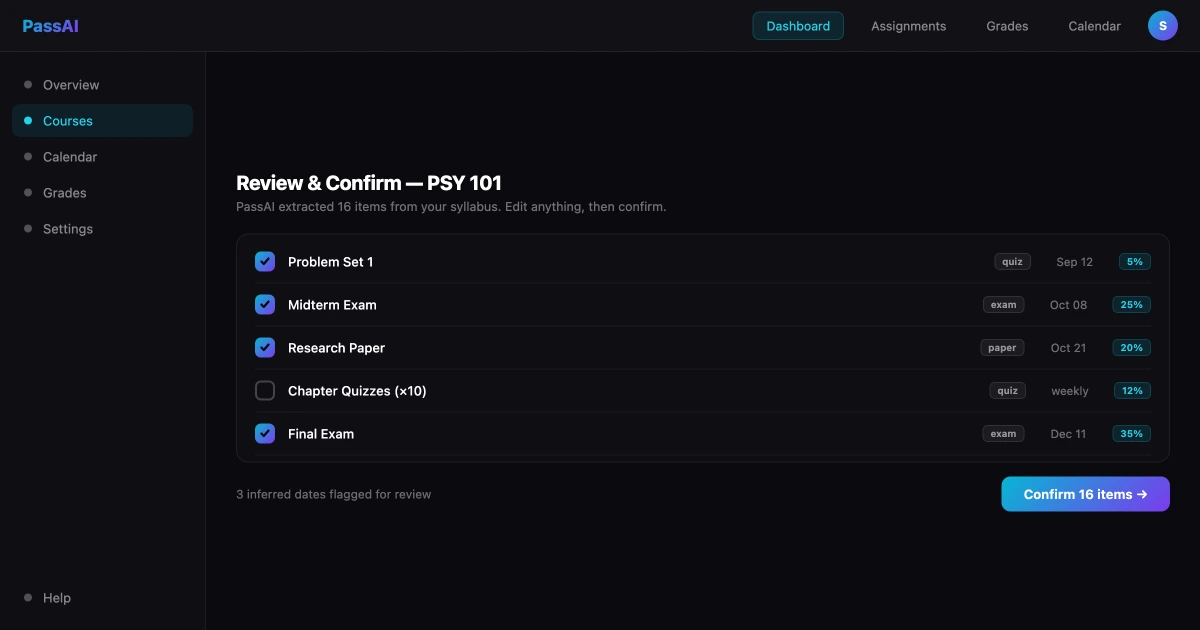
This is exactly the tedious part PassAI automates. You upload the syllabus PDF, and it sends the document to Claude, which reads the actual file — tables, footnotes, multi-column schedules, "see Week 9" references — and pulls out every assignment, exam, and quiz with its due date and grade weight attached. Recurring items like "weekly reading response" get expanded into individual dated entries automatically. The whole thing takes under 60 seconds per syllabus, and you get a Review & Confirm screen to check its work before anything is saved.
What a Good Syllabus Reading Habit Looks Like All Semester
Reading the syllabus isn't a one-time task, even though most students treat it that way. A few checkpoints worth building in:
- Week one: the full careful read described above, for every class.
- Whenever a professor announces a change in lecture. Syllabi get amended — a due date moves, a policy shifts. If your professor says "I'm updating the syllabus," go check it that week, not at finals.
- Before you're ever late on something. Reread the late policy before you assume "a day late is probably fine." Some professors mean it.
- Two weeks before finals. This is when the final exam policy, cumulative content, and grading curve details actually become relevant — worth a re-read even if you read it back in week one.
If you'd rather not re-open five PDFs at each of these checkpoints, that's the actual value of getting everything into a semester dashboard once — the information stays visible without you having to go back to the source document every time. Pairing that with a weekly check-in habit is what catches a moved deadline before it becomes a missed one.
One honest limit: reading the syllabus well tells you what's coming and how much it's worth — it doesn't do the assignments for you, and neither does PassAI. It's a planning tool, not a way to skip the actual coursework. What it does is make sure you're spending your study time on the right things, instead of the things you happened to notice.
The Bottom Line
A syllabus isn't designed to be skimmed, which is exactly why skimming it fails. Read it once, carefully, in week one — pull out the grade breakdown, every dated assignment, and the policies that touch your grade — and you'll know more about your semester than most of your classmates do by week three.
If you want to skip the manual extraction part, upload your syllabus to PassAI and let it read all the tables, footnotes, and recurring patterns for you. Either way — by hand or automated — the fifteen minutes you spend actually reading the document properly is the best-spent time of your entire semester.
Skip the manual extraction. Upload your syllabus and get every deadline and grade weight in under a minute.
Free, no credit card required.