If you use AI to understand your coursework, you are almost certainly fine. If you use AI to produce the work you hand in, you are almost certainly not. That single distinction, process versus product, is the whole of how to use AI in college without cheating. It is also the line most students have never had explained to them.
The gap is not small. According to the Higher Education Policy Institute's 2026 student survey, 95% of students now use AI in at least one way and 94% use it on assessed work, while 12% put AI-generated text directly into what they submit, up from 3% two years earlier. Almost everyone is using it. Almost nobody can quote the rule they are operating under.
This post gives you the rule. Where the line sits, where your syllabus states it, six uses that stay safe under every policy tier, four that get students caught, and how to cite AI when your course requires it.
The line is process versus product
Process is safe, product is not. AI that changes how you understand or organize your work (explanations, outlines, practice questions, schedules) leaves nothing of its own in your submission, so there is nothing for an integrity policy to catch. AI that writes the paragraph, solves the problem set, or produces the code becomes the graded artifact, and that artifact is supposed to be evidence of what you can do.
That is the reason the rule exists, and knowing the reason is what lets you make judgment calls the syllabus never anticipated. Your professor is not grading the paper. They are grading you, using the paper as the measurement. Anything that improves the measurement without improving you defeats the instrument.
Run any borderline use through one question: if I removed the AI, would this submission still exist in my own words? Ask ChatGPT to explain covariance and the answer is yes. You understood it, then wrote it. Ask it to write your methods section and the answer is no. The test takes three seconds and it resolves most cases correctly.
Your syllabus already answers this, in a section most students skip
Your course AI policy is written down, and it is almost always inside the academic integrity paragraph rather than under a heading that says AI. That placement is why students miss it. You are scanning for a word that never appears as a title, in a document you read once during syllabus week and never opened again.
Find it in thirty seconds. Open the PDF, hit Cmd+F, and search four terms in order: AI, generative, ChatGPT, integrity. One of them lands. Universities including Duke, Johns Hopkins, Minnesota, and Arizona State now publish recommended AI syllabus statements to their faculty, so the paragraph you are looking for is increasingly standardized language dropped into an existing policies block.
If all four searches come up empty, email your professor one sentence: "Is AI use permitted on assignments in this course, and if so, how should I disclose it?" Silence in a syllabus is not permission, and an emailed answer is documentation that a detector score cannot argue with. The same close-reading habit pays off across the whole document, so see how to read a syllabus for the other sections that decide your semester.
The three AI policies you'll actually see
Every AI statement you encounter falls into one of three tiers, and the tier tells you exactly what to do.
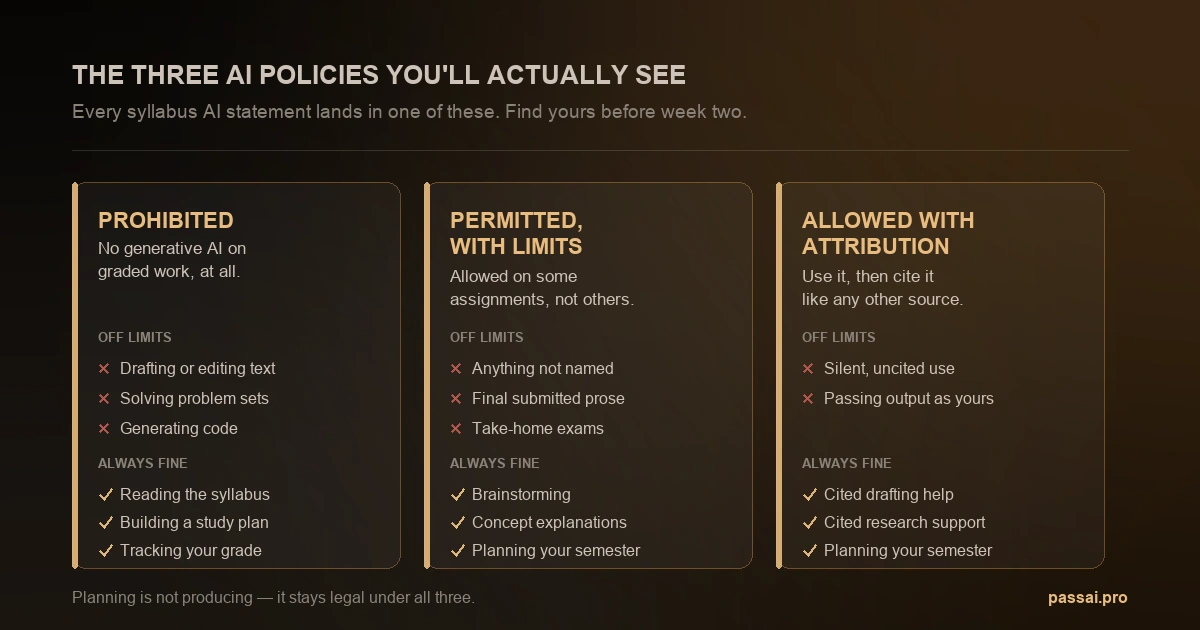
Prohibited. No generative AI on graded work, full stop. Drafting, editing, solving, generating code: all out. Note what is still in: reading your syllabus, building a study plan, tracking your grade. None of that is submitted work.
Permitted with limits. AI is allowed on some assignments and not others, and the assignment instructions carry the specification. The trap here is assuming permission carries across a course. It does not. A professor who encourages AI brainstorming on discussion posts may treat the same tool as a violation on the take-home midterm, and the default for anything not explicitly named is no.
Allowed with attribution. Use it, then cite it. In this tier the undisclosed use is the offense, not the use. A student who used AI and said so is compliant; a student who used the same tool silently is not.
One practical consequence: with five courses you may be operating under three different tiers at once. Write down which class is which in week one, because reconstructing it at 11pm the night a paper is due is when people guess wrong.
Six AI uses that are safe under almost any policy
These six share one property. Nothing they generate reaches your submission. Which tool you use matters less than which job you use it for; if you want the shortlist, we broke down the best AI tools for college students by task.
- Explaining a concept you didn't get in lecture. Paste the confusing passage and ask for it in plain language, then verify against your textbook. You are using AI as a tutor with unlimited office hours, and tutoring has never been an integrity violation.
- Generating practice questions from your own notes. Feed it your lecture notes, ask for 15 exam-style questions, close the notes and answer them. This works because retrieval practice beats rereading, and you cannot fake recall the way you can fake recognition.
- Summarizing dense reading before you read it. A summary first gives you a scaffold to hang details on, which is the same reason a good lecture opens with an outline. Read the actual text afterward; the summary is the map, not the territory.
- Turning your syllabus into a schedule. Extraction is a clerical task with no authorship in it. More on this below, because it is the highest-value legal use available to you.
- Debugging your own code by asking why it breaks. Ask what the error means, not what the answer is. The distinction is real and most CS departments state it explicitly.
- Rehearsing for an oral exam or presentation. Have it interrogate you on your argument and find the weak spot. You get the pressure-test without anything to submit.
Four uses that get students caught
Each of these fails the removal test. Take the AI out and the submission collapses.
Generating prose you submit as yours. The obvious one, and still the most common. That 12% number from the HEPI survey is students doing exactly this.
"Just rewriting" your draft. Feeding your own paragraph to an AI and submitting what comes back feels like editing. It is not, because the sentences that get graded are the model's. Ask instead for comments on your draft, then rewrite it yourself. Same benefit, no transfer of authorship.
Solving problem sets and reverse-engineering the work. Producing the answer first and backfilling steps means you cannot reproduce it on an exam. This one usually gets caught by the midterm rather than the policy.
Running AI-generated text through a humanizer. This is intent, in writing. NBC News has reported on students turning to humanizers to evade detectors, and a hearing panel reads the evasion step as an admission that you knew the underlying use was prohibited.
Planning your semester with AI is never the thing that gets you caught
Academic integrity policies govern submitted work, and your schedule is not submitted work. That is why semester planning sits outside the rules entirely. It stays legal under a course that bans generative AI outright, because there is no graded artifact anywhere in it.
It also happens to be where the time actually is. Copying deadlines out of five syllabi by hand costs an afternoon, which is precisely why most students never finish and end up running the semester out of Canvas, which doesn't show everything.
PassAI does that extraction from the syllabus itself. Upload the PDF and PassAI's syllabus parser pulls every graded item with its weight. On a real history syllabus it found 16: 2 exams at 15% each, 6 quizzes including weekly reading quizzes expanded into individually dated entries, and 8 assignments including a research paper split into rough and final drafts. PassAI's daily plan then schedules backward from those dates, and PassAI's grade calculator tells you what you need on what's left.
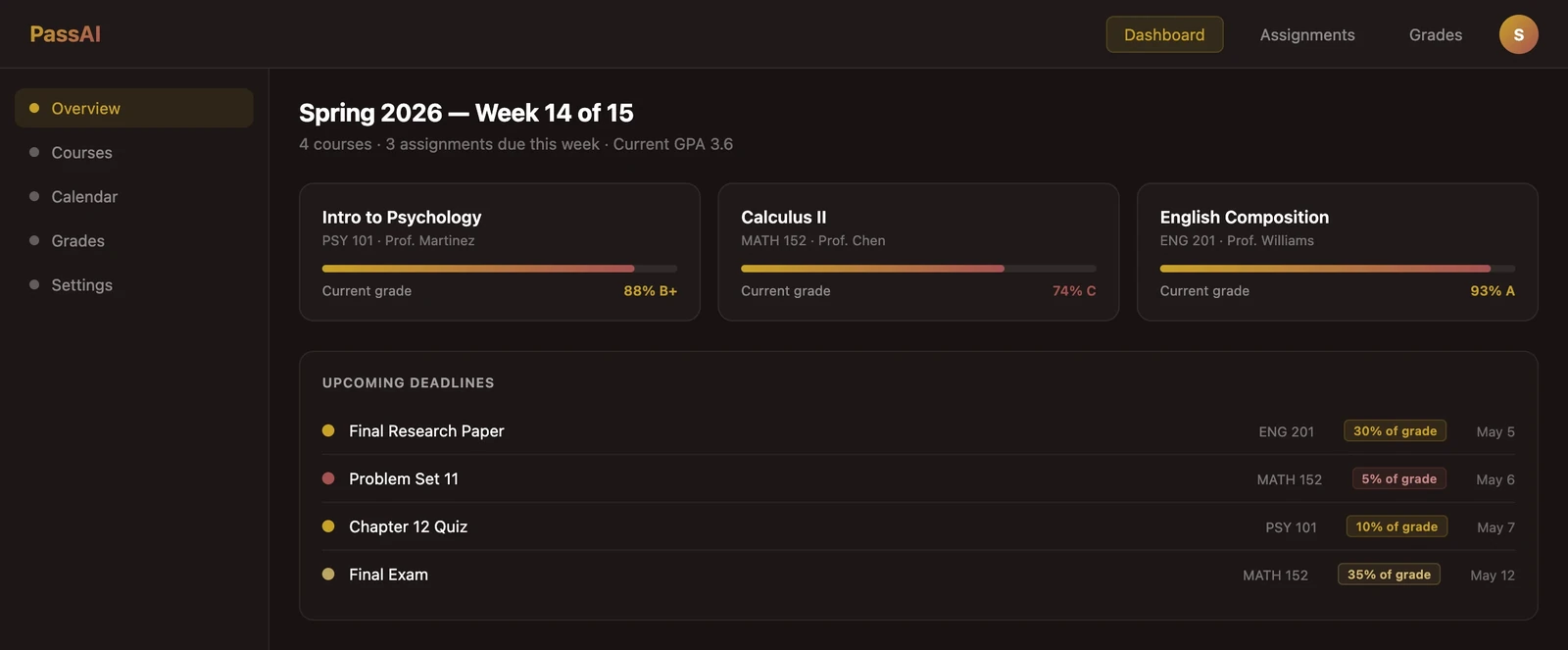
What it does not do is write your papers or answer your problem sets. That is a deliberate product decision, not a missing feature. The tool that plans your semester should not be the tool that puts you in front of an integrity board. It starts with a 14-day Pro trial, no card, then a free plan that keeps 2 classes; Pro is $9.99/month or $24.99 a semester.
How to cite AI when your professor asks for it
Name the tool, the version, the date, and what you used it for. MLA, APA, and Chicago all publish generative AI formats now, and instructors care far more about the disclosure existing than about which style guide you followed.
A methods note at the end of the document handles most courses:
AI use: ChatGPT (GPT-5, August 2026) was used to generate an initial outline and to identify counterarguments. All prose is my own; sources were located and verified independently.
Three lines, and it converts an ambiguous situation into a documented one. Disclosure also protects you against a false positive later, because you have already told your professor what happened before any detector had an opinion.
What AI detectors actually flag, and why you can get accused anyway
Detectors do not detect AI. They score how statistically predictable your writing is, then convert that score into a percentage that looks far more precise than it is. Clean, plain, well-organized prose reads as predictable, so the better your writing habits, the more AI-like you score.
That failure mode has a known bias: non-native English speakers get flagged disproportionately, because writing in a second language tends to produce more common word choices and simpler constructions. A tool that punishes plain writing is not measuring authorship.
So do not build your defense on arguing with the number. Build it on process evidence, and build it before you need it:
- Draft in Google Docs or Word so version history exists automatically.
- Keep your research tabs and notes rather than deleting them at submission.
- Save outlines and rough drafts as separate files with real timestamps.
- Write in more than one sitting, because a document that develops over four sessions looks nothing like one pasted in at once.
If an accusation comes, ask which specific passage raised the concern and walk them through how it was written. A student who can produce six timestamped drafts ends that meeting quickly.
Build your one-page AI rule sheet in week one
Spend fifteen minutes in the first week and you will not have to think about this again all semester. Open all five syllabi, search each for the AI policy, and write one line per course: the tier, whether disclosure is required, and any assignment called out by name. Email the professors whose syllabi say nothing.
Then set up the legal half, every deadline and grade weight in one place, so the AI you rely on all term is the kind nobody can object to. That is the whole system: know the rule per course, use AI on your process, keep the product yours, and document as you go.
The students who get in trouble are rarely the ones who read the policy and made a call. They are the ones who never found the paragraph. Find yours this week. If you want the other half handled, upload a syllabus and let PassAI's parser build the schedule while you keep the writing.